How to Become a Physical Therapist

Steps to becoming a PT:

  1. Earn a Bachelor’s degree from an accredited college Any degree is accepted as long as the prerequisite courses are fulfilled. Prerequisites differ by school but most programs require prerequisite courses in anatomy and physiology, biology, chemistry, psychology, and statistics.

2. Complete a Doctoral Physical Therapy degree

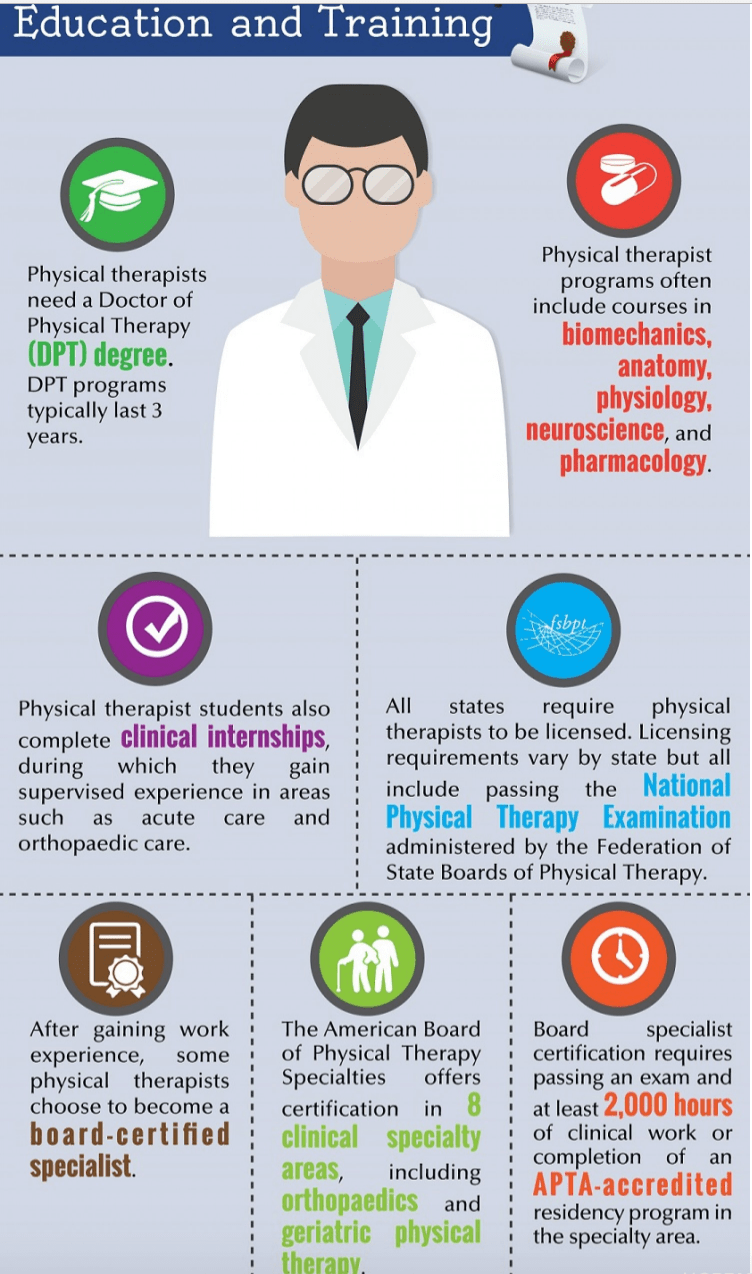
Doctor of Physical Therapy degree programs are 3 years long and consist of coursework as well as clinical experience. Coursework in the program includes applied physical therapy, functional anatomy, complex conditions, lifespan development, and pharmacology. Clinical experience includes internships at a variety of different settings.

3. Pass the National Physical Therapy Examination

Each state has it’s own licensing requirements and state licensing exam. Physical therapists must pass the exam for the state in which they wish to practice. Same states may also require and law exam and/or criminal background check.

How to Become (n.d.). How to Become a Physical Therapist: Physical Therapy Schools and Careers Retrieved from learnhowtobecome.org


Typical Workday

The day-to-day job of a physical therapist consists of working one on one with patients evaluating/reevaluating them and creating specific treatment plans tailored to each individual. Many challenges present in the everyday work of physical therapist as they try to accommodate each patient and create a treatment plan that will be the most effective. Another important aspect of a physical therapists job is documenting patient progress and filling out charts/records. Physical therapists typically work 8-12 hour days, 5-6 days a week. The environment in a physical therapy clinic is fast paced and requires quick thinking and transitioning between patients.

According to physical therapist, Morgan Romans, “A day in the life a Physical Therapist is typically really fun! As an outpatient orthopedic Physical Therapist, I work in a fast paced, challenging clinic that includes patients across the lifespan that may have any type of musculoskeletal issues, whether it be due to a traumatic incident, post operative conditions, or chronic pain symptoms”. Morgan also states, “The majority of physical therapists have quite a lot of documentation to do, so not only is time devoted to patient care but also filling out charts and documenting treatment through an electronic medical record”.

Career Contessa (2016, November 3). Personal Interview.

The Physical Therapy Profession

Physical Therapy is a growing profession and is a rewarding career, both financially and emotionally. Physical therapists work in a variety of different settings, treating a variety of different patients. They may work in hospitals, schools, private clinics, out patient clinics, rehabilitation centers, or emergency rooms. Patients may range from babies to elderly people with a variety of different conditions or injuries. People trying to become physical therapists must undergo rigorous schooling, obtain clinical experience, and pass a licensure exam. After becoming and gaining experience as a licensed physical therapist, there is the option to become a board certified specialist. There are many different areas of specialty a physical therapist may choose to work in.


Best Physical Therapy School Infographic [Digital Image]. Best Physical Therapy Colleges. Retrieved from bestphysicaltherapycolleges.co

Screen Shot 2018-10-01 at 9.45.37 PM.png